
Author: Mikayla Krisanda
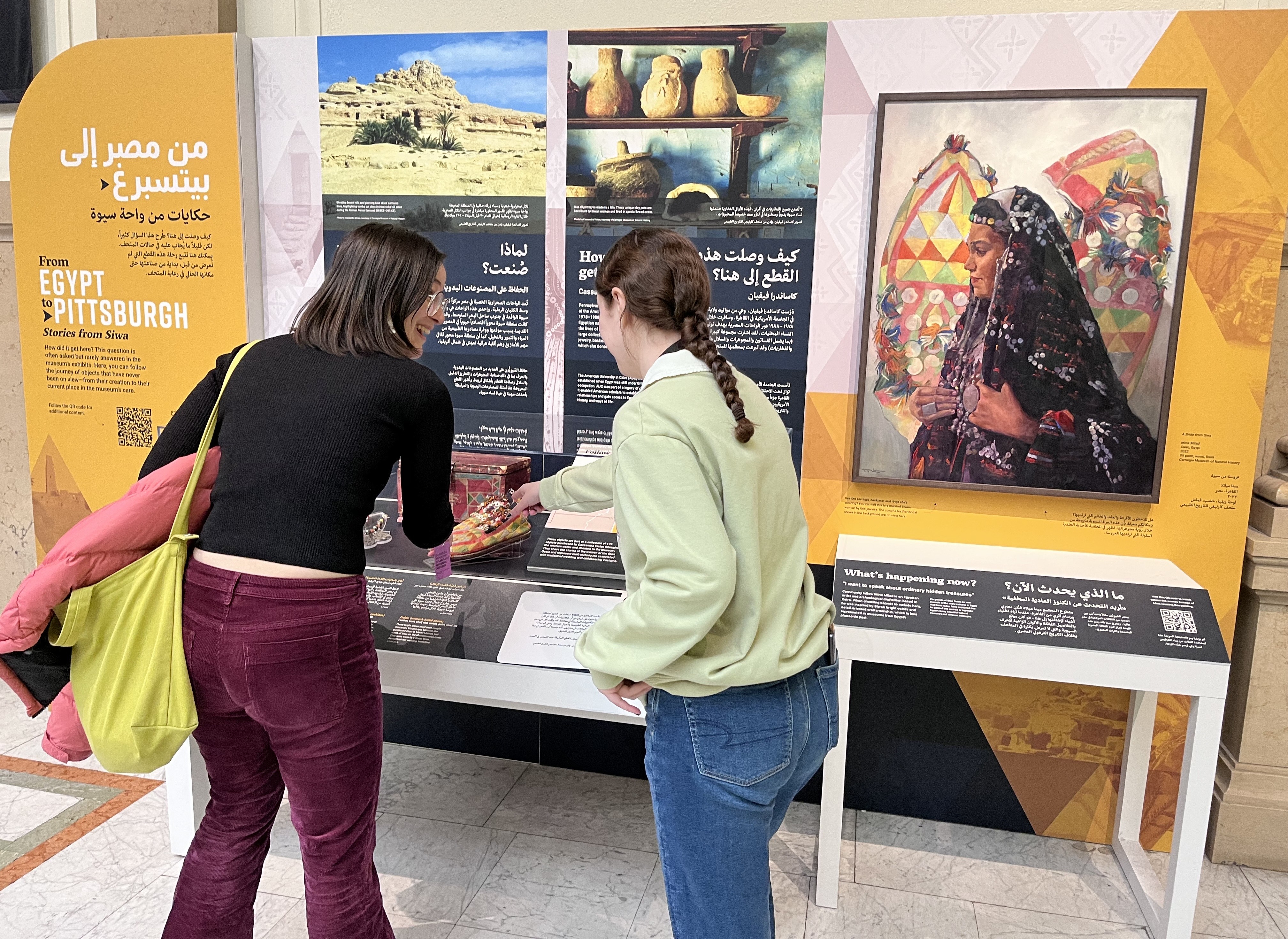
At the Carnegie Museum of Natural History (CMNH) there are many ways for visitors to make their way around the museum. Through my internship at the CMNH, I have found that visitor pathways have a major effect on interactions with displays and exhibitions. As part of my internship at the CMNH, I have been observing visitor interactions and administering surveys to visitors regarding the 3rd rotation of the From Egypt to Pittsburgh display.
The From Egypt to Pittsburgh display is located against the wall to the right of Bird Hall on the third floor of the museum. It sits in between the currently closed Walton Hall of Ancient Egypt, Polar World: Wyckoff Hall of Arctic Life, and Alcoa Foundation Hall of American Indians. The observations and survey responses from visitors have allowed me to form an important conclusion: the location of From Egypt to Pittsburgh does influence how many visitors view the display and how they interact with it as well.
Observations of interactions revealed that visitors coming from The Stories We Keep exhibition in R.P. Simmons Family Gallery through Bird Hall were much more likely to skip the From Egypt to Pittsburgh display entirely than those coming from the Grand Staircase or the elevators. The display is against the wall directly to the visitor’s left when coming through Bird Hall, so it seems to blend into its surroundings. On either side of the display, there are two large granite Egyptian statue replicas, one of the Goddess Sekhmet and the other of Amenhotep III. These statues tend to draw the visitor’s eyes away from the display in between them due to their size.
According to the results of the 53 total visitor groups observed between January and April of this year, 29 of them were recorded interacting with the From Egypt to Pittsburgh display for less than one minute. I believe that the location of this display limits its visibility and attractiveness to the passing visitor. Despite the incorporation of interactive components like the flipbook, painting, QR codes, and map, its position against the wall causes visitors to look beyond its features and towards the CMNH’s other anthropological exhibits.
In the 3rd floor atrium, there are both artifacts and smaller displays outside of Walton Hall and Wyckoff/Alcoa halls that are directly in the visitor’s line of sight when coming from the Grand Staircase or Bird Hall. These displays include a totem pole titled “The Hunt,” a limestone sphinx, stone sarcophagus, and a sculpture titled “Pharaoh Sety I makes an offering to the God Horus.” The Totem Pole and Pharaoh sculpture are both very tall and brightly colored, which could explain why the visitor’s eye is more often drawn to them. Both the limestone sphinx and the stone sarcophagus are in glass cases directly across from the entrance to Bird Hall which also makes them more noticeable to the visitor.
The results from these visitor observations have allowed me, as well as the other museum staff involved with From Egypt to Pittsburgh and other exhibits, to learn how the location of these displays influence visitor’s interactions. From this data, museum staff can better understand how and why visitors choose to interact with displays and exhibits. They can also make changes to increase these interactions as well as overall visitor satisfaction during their time at the CMNH.