
Author: Shawn C. Simmons
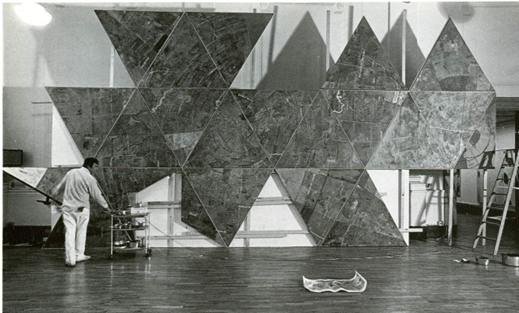
Jasper Johns working in his East Houston Street studio on Map (Based on Buckminster Fuller’s Dymaxion Airocean World), December 30, 1970. Photo by Hans Namuth.
Over nine million visitors flocked to the United States Pavilion at the 1967 International and University Exposition in Montreal (Expo 67). Measuring twenty stories high and 250 feet in diameter, the Buckminster Fuller-designed geodesic dome welcomed international spectators to explore its theme of “Creative America.” Passing through the displays of aerospace technology and photographs of Hollywood stars, visitors would have encountered Jasper Johns’s largest painting to date, entitled Map (Based on Buckminster Fuller’s Dymaxion Airocean World). Composed of 22 geometric panels joined together, Map was a direct reproduction of Fuller’s Dymaxion map, a cartographic model that projects the globe onto an icosahedron (a 3D shape with 20 faces) to achieve a more accurate and proportional world map. When Johns visited Expo 67 himself, he was dissatisfied with the painting and its identification as a map rather than a work of art. After the exhibition closed, he spent the next five years completely reworking Map as he questioned ideas of cartographic objectivity.
What role does embodied experience play in our understanding of space and place? Where exactly does the line fall between the cartographic and the painterly? These were just some of the questions I contended with throughout our graduate Constellations seminar, Space and Place: Topographies of Power and Resistance. They began to emerge in our very first meeting, in which each participant was given the open-ended prompt to present their own “spatial biography.” As individuals began sharing stories based on their own interpretations of this term, it became clear that our perception of space is inherently tied to embodied experience—it is shaped by myriad emotions, memories, and physical senses. In Earth-Mapping: Artists Reshaping Landscape, philosopher Edward S. Casey offers the term “mapping with/in” to describe this sort of embodied geography: “To the degree that I find myself with/in the living landscape, I am part of that landscape, just as it is part of me. The boundaries between myself as mapmaker and the earth I map—boundaries that become strict borders in the case of the official cartography, who is a representative of a ‘major science’—are porous when I bodily feel a given landscape.” Building on Casey’s approach, I am particularly interested in how the relationship between self and space manifests in maps, which have already undergone a degree of transformation (and therefore distortion) from the abstract concept of space into tangible, visual, and material forms.
So, how exactly did Johns address his own entanglements with Map? His formal interventions included shifting the painting’s orientation, abstracting various geographic features, and adding layers of collage and encaustic to the surface. Moreover, his ideological intervention of distortion-as-method rejected any semblance of cartographic legibility. Map’s refusal to be read as a neutral and accurate depiction of space blurs the line between what we consider to be “map” versus “art.” Johns’s idea of refusal meant relocating himself in the artwork through the long process of reworking, enacting his own sort of mapping with/in. Through reevaluating and redefining those boundaries, one finds new avenues for understanding the relationship between space, place, and identity.
It is worth noting that Johns was no stranger to the map as subject matter. In a gallery label accompanying one of the artist’s well-known abstractions of the U.S. map, the Museum of Modern Art notes Johns’s view that “the map of the United States, in its ubiquity and iconicity, is ‘seen and not looked at, not examined.’” Why, then, did Expo 67 prove especially troubling for Johns? Let us return to where we began: the decision to initially present the painting on the world stage, within Fuller's geodesic pavilion and an exhibition themed “Creative America,” carries notable political and cultural implications. In the context of the pavilion, which aimed to showcase American innovation on the world stage, Johns's initial dissatisfaction with the work being identified as a map rather than a work of art might be understood as a reaction against the nationalistic narrative being propagated. The exhibition likely felt constraining for Johns, whose work often employed ambiguity to examine familiar symbols. This nationalistic display of achievement and innovation in art and technology was strategically curated, and Johns may have sought to distance himself from its undertones. Refusing and reworking the map allowed him to push against the conflation of art with cartography and question conventions of spatial representation. As I continue reflecting on this work, I wonder: How else might the map function as a dynamic space for alternative forms of embodiment?